Blogs May 4, 2026 |
Enterprises with geographically dispersed locations frequently encounter challenges when connecting sites that fall outside of a private network footprint. Extending full private wire services to every location is often cost-prohibitive and slow to implement. As a result, off-net sites must rely on PSTN connectivity, which traditionally treats calls differently from on-net traffic. This separation can lead to inconsistent call routing, higher toll charges, and a fragmented user experience.
Another issue is protocol mismatch. Different locations and systems may require different line types or signaling protocols. Without a hybrid approach, enterprises are forced to deploy multiple parallel services or complex gateways to translate between protocols. This increases architectural complexity, maintenance effort, and the potential for service disruptions.
Integration at the terminating end is also a concern. Calls must reliably reach a B end destination, which may be an enterprise PBX or a modern collaboration service. Managing separate ingress methods for private wire and PSTN connections places additional strain on telecom teams and complicates troubleshooting. Moreover, during outage scenarios, many environments lack predefined mechanisms for quickly rerouting calls.
Finally, business continuity and disaster recovery demand predictable inbound calling behavior. Without specific Direct Inward Dialing (DID) assignments dedicated to Business Continuity Services (BCS) and Disaster Recovery (DR), organizations risk losing inbound accessibility during critical incidents, directly impacting customers, partners, and internal operations.
XOP Networks presented this solution of Hybrid ARD to resolve these challenges by combining two different line types into a single hybrid service. By using one half private wire and one half PSTN, the service performs protocol conversion between the two ends so that each side receives the line type it requires. This allows enterprises to maintain private wire characteristics where needed while leveraging PSTN reach where it makes the most sense. Most importantly, the end not making the change is not encumbered by the expense of the distant end’s transformation.
The most typical Hybrid ARD deployment uses ARD on one end and PSTN on the other to support off-net locations. With this architecture, any off-net location can effectively function as on-net. Even though part of the call path traverses the PSTN, the hybrid service presents the call to the enterprise network in a manner consistent with private wire connectivity. This preserves dialing simplicity, cost predictability, and call quality expectations.
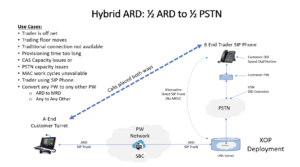
Hybrid ARD also simplifies termination options. Calls can be delivered directly to a B end PBX, allowing enterprises to retain existing call control, numbering plans, and user configurations. Alternatively, calls may be routed to a collaboration service, supporting cloud-based communications and remote work strategies. This flexibility enables gradual modernization without disrupting established workflows.
A key feature of Hybrid ARD is the use of specific DIDs for BCS and DR. These DIDs are preassigned and engineered to support rapid rerouting in the event of failures. During normal operations, calls flow to the primary PBX or collaboration platform. During an outage, those same DIDs can be redirected to backup systems or alternate collaboration services, ensuring uninterrupted inbound calling.
Operationally, Hybrid ARD reduces complexity by presenting a unified service model rather than two independent networks. Telecom teams can manage routing, monitoring, and support more efficiently while still benefiting from the strengths of both private wire and PSTN infrastructures.
Thought leaders continue to write about the ubiquity and revolution of the brave new world of soft turrets. However, the reality that they overlook is how the past is integrated into that reformation. XOP Networks addresses that issue head on with its Universal Services Node and its inherent ability to integrate the legacy, present and future all in one simple solution that can be deployed on pre, in the cloud, or in a data center, and its highly available and redundant. What’s more, they have been doing it for almost 25 years without any downtime.
Hybrid ARD service provides a practical and resilient solution for enterprises navigating the realities of hybrid voice environments. By combining half private wire and half PSTN, it bridges protocol differences, reduces costs, and extends on-net behavior to off-net locations. Its ability to terminate to a B end PBX or collaboration service ensures compatibility with both legacy and modern systems.
With dedicated DIDs for business continuity and disaster recovery, Hybrid ARD delivers built-in resilience and predictable inbound calling even during disruptive events. For organizations seeking to modernize their voice architecture without abandoning existing investments, Hybrid ARD offers a balanced, flexible, and future-ready approach to enterprise communications.
Bill Wagner is a Financial and Command and Control industry strategy and technology consultant with over 30 years’ experience as an industry executive in hardware, software, engineering, operations, R&D, product development and introduction, and strategic development.
Written by :
Bill Wagner, President, Wagner Consulting
 Login
Login