“Sir I cannot hear you” – Air Traffic Management Out of Control?

The Problem

Unless you have been hibernating, you have heard about the recent voice communications outages in our multiple Air Traffic Control centers. You remember voice communications, don’t you? Invented in the 19th century and eulogized many times as shinier objects take center stage, voice  is a critical means of communication especially in the financial industry and in command and control. While E911 and other services evolve to include SMS, video, and other features, connecting to a human being on a reliable system that is clear, simple to use, and recorded for compliance is still the foundation of critical communication.

So then why is century old technology failing so often and putting people lives in danger? Voice is looked down upon by today’s technology elite. It does not attract investment. No one wants to make hardware. Everything has migrated to the cloud. While these may not be negative developments, there are legacy systems that are no longer supported that are aging and may not be easily migrated to the cloud. Voice system manufacturers are abandoning their embedded base every day and summarily ending product lines with little to no warning. Some will argue that we took a very simple technology, analog voice, and made it extremely complex with VOIP and its many considerations. Yes, it reduced the costs for consumer and general business, however for critical communications, it reduced the number of vendors and the market size for those vendors thus driving up the price. Government specifications can be complex, and those requirements may not exist in this APP culture and thus drive higher cost customized solutions where once the same PBX provided overlays for every market segment.

So how do all those issues manifest to create the crisis we have seen unfold over the last few weeks? Some level of government issues a Request for Proposal (RFP) that requires technologies and methods that may no longer be available and have to be created for modern platforms. Government bids can take years to create, garner responses, decide, procure, and implement. Many large governmental contractors and integrators take the approach to bid low and make more money in change orders. This drives up costs and elongates the time for deployment, often by years. Antiquated legacy systems must now survive even longer, may not be properly supported, and have contracted service providers scouring online auction sites for spare parts. Add to that the reduction in qualified staffing for cost savings, and it can culminate in a perfect storm of 90-second service failures to critical voice infrastructure at Air Traffic Control towers.

The Solution

The technology problem is not difficult to solve. However, the implementation is often likened to repairing the engine on an airplane in mid-flight. The legacy system should remain untouched. Its delicate status combined with the need for it to operate in a critical environment means high risk to any well-intentioned interim repair. The new system is not production ready and must be extensively tested so as not to introduce new issues. What can be done is to introduce an interim parallel system that leverages the reliable portions of the old solution and provides an alternative that is always available. Bridging the past, the present and the future is the sweet spot for some vendors. Technologies such as gateways, and protocol conversion can provide that evolutionary step from the legacy world to the new world on an interim basis without migrating the entire solution. By inserting these technologies and integrating them via a standards-based API, business continuity is achieved while disaster recovery efforts are conducted in parallel. Properly handled, it can be transparent to the user.

We must rely on publicly available information and make some assumptions. The first assumption is that the failure was only at the voice system. Secondly, we can assume that radar, geospatial data, and the integration of that data to air traffic control center operational systems – all continued to perform. Third, we can assume that the VHF radio network was up and reliably running. Finally, we can assume that the same radar and geospatial data can be presented to another system. Detection of a failure may also be possible which could trigger an automated switch over to the interim system. Or you can simply put a backup device on each desktop. The best backup is one that is always available and requires no intervention.

By taking that same data and matching it to the aircraft identification and geospatial coordinates, a new system can transfer that call to a specific controller in a specific region. A new conference is then created between the aircraft and the controller. It can be handed off as the location changes to a new center, and integrated chat/IM/SMS/Email or any other alert can be triggered and every event logged as desired. A simple example of this is E911 where your phone number is looked up in a database and an address is matched and overlayed on a map and is instantly presented to the E911 operator, then to police, fire, or emergency service dispatching.
If the controller is connected to the new bridge, and the new bridge is connected to the legacy voice service and the VHF radio via Radio Over Internet Protocol (ROIP) Gateways, then a failure of the old system will never even be noticed. Or both systems can exist in parallel. It can work either way, whichever is the best operational fit for the circumstances.

Conclusion

Although this may seem oversimplified, the concept is sound. The variable is a vendor. When you require a partner with extensive aviation emergency experience, who has had thousands of ports in service spanning multiple years without a single failure you turn to XOP Networks. XOP Networks has been providing RFCS (Ringdown Firebar Conferencing Service) to global airports both civilian and military (including the US DoD) for decades, allowing them to achieve FAA regulatory compliance. Their Universal Services Node (USN) provides Mass Notification to municipalities and schools, provides Command and Control conferencing during rocket launches and provides secure trader voice services to financial institutions on Wall Street. Their REST API allows for the integration of 3rd party software and data for additional features and functionality and enhancements to services outlined above. It can operate in a highly available configuration in the cloud, on servers in a datacenter, or a hybrid configuration. It can integrate with existing directories and identity systems, and integrates with recorders, transcribers, and analytic systems.

So why hasn’t a similar solution been put in place yet? Great question. Anyone who is interested can contact XOP at (972) 590-0200, at sales@xopnetworks.com, or at our website at https://www.xopnetworks.com/. XOP Networks, an American company, located in Dallas Texas, and ready to roll up their sleeves and help solve this problem, and already has an extensive track record of helping to keep passengers safe in an emergency.

Bill Wagner is a financial industry technology consultant with over 30 years’ experience as an industry executive in hardware, software, engineering, operations, R&D, product development and introduction, and strategic development.


Revolutionizing Wall Street Communication: The Power of Hitless Switching in IP-Based Hoot and Holler Applications

Introduction

In the fast-paced world of Wall Street trading, seamless communication is paramount. Traders rely on instant, uninterrupted connections to make split-second decisions that can significantly impact their financial outcomes. Traditional communication systems often fall short, requiring traders to redial and rejoin conferences during technical disruptions. However, with the advent of hitless switching in IP-based Hoot and Holler applications, this challenge is being effectively addressed.

What is Hitless Switching?

Hitless switching is an innovative technology that allows calls to transition between hoot bridges without any noticeable disruption. Unlike traditional methods that require traders to redial to join a new hoot conference, hitless switching ensures continuous communication, maintaining the flow of information without interruption.

The Importance of IP-Based Hoot and Holler Applications

IP-based Hoot and Holler applications are essential tools for traders, providing instant communication channels that are crucial for sharing market updates, trading positions, and strategic decisions. By leveraging IP technology, these applications offer enhanced reliability and audio quality compared to traditional leased line-based systems.

Benefits of Hitless Switching

-Seamless Communication: Traders can continue their conversations without any interruptions, ensuring that critical information is shared in real-time.

-Increased Efficiency: Eliminating the need to redial saves valuable time and reduces the risk of missed opportunities.

-Enhanced Reliability: IP-based systems provide more stable connections, reducing the likelihood of technical issues that can disrupt communication.

Real-World Impact

The implementation of hitless switching has received positive feedback from traders who appreciate the uninterrupted communication and increased efficiency. This technology is transforming the way traders interact, allowing them to focus on their strategies without worrying about technical disruptions.

Conclusion

Hitless switching in IP-based Hoot and Holler applications is revolutionizing communication on Wall Street. By providing seamless transitions between hoot bridges, this technology ensures that traders can maintain continuous, efficient communication, enhancing their ability to make informed decisions in a fast-paced environment.


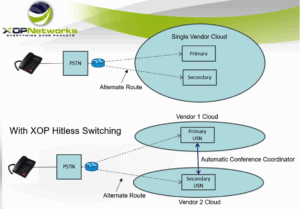
XOP Networks’ Universal Services Node (USN), a state of the art conferencing and collaboration bridge supports IP based Hoot and Holler application with ‘hitless switching’. Typically, the H-n-H conference runs on the Primary USN and simultaneously a proxy H-n-H conference runs on the Secondary USN.

The Automatic Conference Coordinator capability of the USN is always aware of the health of both the Primary and the Secondary USNS. If the Primary USN conference server or the cloud provider network fails, the Automatic Conference Coordinator quickly enables the H-n-H conferences on the secondary conference server located in a different cloud vendor’s network, datacenter, or premise-based server without any intervention. With hitless switching, the traders using the H-n-H conferences are unaware that their conference has moved from Primary USN to the Secondary USN.

Here is a highly technical secret:  If a user must dial back in, or an admin has to restart something, it isn’t automatic failover.

Is there a good reason for your email interface, folders, files, chat/IM, PSTN and collaboration to all be in one environment? If there is, that’s great. But if you only purchased that option because of the old adage about never getting fired if you bought a particular enormous vendor, shouldn’t it work? By integrating a separate multi cloud system, you can decrease your exposure and increase your security. XOP offers secure remote access, LDAP compatibility, and CAPEX and OPEX service options.


Conclusion

I was the Chief Engineer of a global telecom company that was about to IPO a few years back. At an event, I asked a customer why they went with us, and not a larger company. The answer was that they were a little fish in the scheme of things, and that our pond was smaller. They could call me or our CEO on our cell phones and know they had the ear of someone who cared about their business and would help them with the problem. I was impressed by that answer and have always remembered the conversation. If I couldn’t say the same about the vendors that I was considering, why would I do business with them? Critical communications such as Financial or Command and Control cannot tolerate 2-hour outages or such a total lack of diversity, redundancy, and proper testing prior to a commercial release. If your communication infrastructure is as critical to your enterprise, then perhaps you should be speaking to your XOP Networks representative about their conferencing, collaboration, mission critical voice, and other integrated services today.

Bill Wagner is a financial industry technology consultant with over 30 years’ experience as an industry executive in hardware, software, engineering, operations, R&D, product development and introduction, and strategic development.

AI and Enhancing Trader and C2 Voice

The Problem

Is Artificial Intelligence just another shiny object, or can it positively impact your business? Every other job posting seems to be for an AI developer. For  certification factories it’s a bonanza. However, AI developers are long on demand and short on supply. The cynical part of me looks forward to when AI can develop itself without human oversight and the certification factories and developers du jour are looking for new opportunities. Six fingered photos and plagiarism arguments aside, are there opportunities to put this to revenue producing or cost saving use? I for one believe there are, and that  it’s never as simple as a LinkedIn video would have you believe. Knowing there is a dearth of development talent, do you buy, build or partner to catch the market window before your competition?

Years ago, a friend selling communications equipment told me a story of his pitch to his customer, a business owner. He told him they could reduce headcount and cost with this new solution. Specifically, operators and secretaries, as the automated attendants, and voice mail, on this new PBX would replace them. It was a family business. The operator was his mother, and the secretaries were his extended family. He lost the sale but learned a lesson. Technology has long promised, but has it delivered those efficient tools that give employees more free time, or more time to do their real jobs? Arguably, it has led to more demands on their time based on assumptions about the efficiency. Reduced staffing has meant more stress among the remaining employees. The current generations have rejected the ‘rat race’ lifestyles of their parents and grandparents. Is it possible to strike a balance and generate that win-win?

The Solution

 I will leave the hierarchical types and numbers of  AI models to other authors. However, the automation of repetitive tasks is a valid and common use case. In its simplest form, AI can help achieve that. We have all interacted with chatbots or auto attendants and have varying opinions on the experience. Like anything, you get what you pay for. If you invest in the development and training of the bot, your customers will have a more valuable experience. When a client has to say ’representative’ ten times to get a live person because your selections, logic, and training failed to resolve your customer’s problem, you have wasted your money possibly at the expense of your customer. Lesson one is to pick the right application, and make sure you properly invest in the project.

Voice assistants are another powerful too, that did not begin as an AI application but are being powerfully enhanced by it. I use one every day, and for me, as it’s on a separate dedicated device that doesn’t take up my real estate on my screen and doesn’t require me to press or open anything, I enjoy using it. It often fails on more complex questions; however, the new AI version will be shortly released that promises to rectify that shortcoming. So, it has replaced my typing in a browser hoping for a good return and scrolling past the sponsored items that I didn’t ask for to get to my answer. It enhances my experience, and I can continue to multitask with two free hands.

How do we add the value of repetitive task replacement with the enhancement of task? By consuming and presenting large volumes and varieties of data so that a user can synthesize it in their daily roles.

Consider a trader with screens full of changing charts, TV audio playing, internal and external hoots and shoutdowns being broadcast, calls coming in and going out to specific traders and firms are being made and logged and you can’t access it. Social media, news and market information are constantly changing, memos and emails are constantly coming in, voice recorders are transcribing events that you had no idea were even taking place let alone having access to. And there they are in the middle of that cacophony as the human information processor responsible for synthesizing everything into a transaction that will make your firm a great deal of money.  Now imagine you are that same trader, and AI was synthesizing all of that for you and presenting it into one easy to consume, visual user experience.

Using that same technology in Command and Control (c2) applications, information may be sent on social media long before the first emergency services call is ever made to  public safety officials, especially where the geography is remote or that hour is late. A report of some natural catastrophic event may begin as a post to a group. Hey, did you feel/hear/see that? By aggregating all of those same feeds and social media, can a disaster preparedness center get a jump on the response to an event in the same way the trader could and thus saves lives?

Conclusion

Systems Integrators, who supply mission critical solutions such as XOP Networks, are building AI into their core applications such as their Universal Service Node that provides financial industry and C2 critical communications systems.  Whether it is for their own customer service application, or for traders and first responders to visualize, synthesize and respond to massive amounts of data, XOP is focusing on enhancement use cases. The technologies mentioned above are available and in commercial use today. None of this is a vaporware or futures discussion. While your specific applications and integrations may require development or SDK/API work, these tools will assist with the dissemination of vast amounts of data to help humans make better, faster, and more informed decisions that can impact financial success and public safety.

Anecdotal Chat GPT use cases may be getting all of the press, but business applications will drive the success of AI and determine whether it is a flash int the pan or has longevity beyond the next shiny object. As with anything, how solutions providers architect and market the value will make the difference. So, learn the lesson of pitching the staff reduction aspect of the business  owners family with automation,  and instead focus on the value of the result. Visualizing and enhancing voice communication has always been a challenge, and XOP Networks is helping enterprises realize the value of the data they have access to and are turning that potential into voice with vision.


ROIP Gateways: The Trusted Airport ‘Crashphone’ System and Its Capabilities Beyond

The Problem

Communicating over a distance has always presented a challenge to humans. From signal mirrors, semaphore flags, and satellites, people have leveraged technology to overcome communications challenges. In my Army days I had radio relay system in my vehicle that took up half the space, so that I could extend the reach of battlefield commanders to their resources. Today, we take speed, availability, and distance for granted with such innovations as cellular telephony, and Starlink. However, in a mission critical environment such as Command and Control (C2), this presents a unique challenge. The communication must be instant, reliable, and able to reach the responders regardless of where they are and what they may be using for communications.  Add to that the need for immediate access to decision makers and experts, and the complications begin to pile up.

How does a dispatcher in an emergency center served via the cloud not only reach their field assets, but the experts and leaders necessary to coordinate a unified response? That dispatcher may be on a console with a Radio over IP (ROIP) interface while the field assets may be on push to talk (PTT) radios, and the experts and leaders who may be travelling and on a cell phone or in conference room located far away in a municipal capital. How does an IT manager securely integrate, provide universal and secure remote access, and archive it for later analysis and compliance? C2 is estimated to be a $45 Billion market with a 6.6 CAGR by 2029. So, solving these problems is not only critical for emergency preparedness, but is a lucrative market for potential vendors.

The Solution

Mass notification services have become standard fare for municipal communications. With one call civic leaders can reach all their residents without sirens or public address systems. These can be further integrated with SMS to send the same message via text messaging, email, or other forms of media. In airports, these systems are used as ‘crash phones’ to bring all the airport emergency services and management together on one system rapidly, securely, and independently of the device they use for communicating. This same concept that has served airport management for years will work in other C2 use cases as well.

Imagine the first responder on the scene on a handheld radio, their supervisor enroute in a vehicle, the dispatcher at a console in a command bunker, and emergency management resources in a conference room, or in transit. You need one system capable of bringing all of them together. Specifically radio, VOIP telephony, cellular telephony, collaboration and conferencing services, and their underlying infrastructure. To do this you need a common denominator – SIP. XOP Networks provides the pieces required to integrate this secure, reliable, universal service. Their services can be deployed in a highly available manner, using data centers, cloud, premises based, or in a hybrid model.

Starting at the edge, XOP provides a ROIP gateway that can be deployed on a processor in your existing routers, or in a separate dedicated unit or units in a diverse, redundant fashion. They also provide the Universal Service Node (USN) which can convert and bridge any protocol into one conferencing system which supports voice, video, chat, screen sharing, document sharing and does so securely and privately on a platform dedicated to your requirements. XOP also provides device independent access to the USN, so users can dial in from a satellite phone, cell phone, VOIP phone, collaboration system, or use any device with a browser to access the conference. Through its robust API, XOP provides a variety of recording, AI, and other interfaces and integrations to comply with recording regulations and all 3rd party applications and partners with the best of breed MSPs and manufacturers should their customers desire one stop shopping. XOP has even developed custom software and designed CPE telephone stations to meet specific customer requirements.  And of course, they provide professional services to manage your project from start to finish and maintain it for the life of the system.

Conclusion

As the technology landscape continues to evolve, ROIP will evolve as well. How will technologies such as AI inference and network slicing provide new features and functionality to this market? Will enhanced mobile broadband/massive machine type communications provide large groups of first responders and their support to areas requiring a temporary or even long-term large emergency services presence? Using the airport crash phone example, how does a regional airport scale to support a massive first responder presence if an incident occurs and lasts for extended periods of time? Access is one portion of the solution, but as the access evolves and presents greater numbers of users, you will require a flexible, scalable, proven collaboration system to integrate and efficiently bridge the audio, video, and sharing for any given situation.

No matter what the future may hold, C2 use cases cannot tolerate service interruption as their constituents face potential life or death situations. XOP networks provides these services in a comprehensive solution that ticks the boxes of technology, compliance, procurement, reliability, and performance. They are acutely aware that the acronym CIA (confidentiality, integrity, and availability) is a critical component of any IT policy. Their solutions have been used by users and vendors to provide over 1 million ports of secure services for over 20 years without a millisecond of downtime. These customers and users include service providers, government, financial institutions, the military, first responders and more.

When you select a vendor partner, you choose one based on experience, reliability, performance, and TCO. XOP excels in these areas as is evidenced by their 25-year history in the very demanding C2 and financial sectors. Is your C2 systems integrator an XOP partner? If not, you may want to have them contact us today for a demonstration and discussion of their solutions. As a former XOP customer, I can assure you that after we did, they were deployed in our cloud environment globally. The value was unparalleled, and the decision was easy to make.

Bill Wagner is a command and control, and financial industry technology consultant with over 30 years’ experience as an industry executive in hardware, software, engineering, operations, R&D, product development and introduction, and strategic development.

Secure Remote Access to Voice Services

Secure Remote Access

The Problem

Remote work is here to stay for financial and efficiency reasons. Leaders can either continue to bemoan that fact, or they can help their CIO’s craft a strategy that aligns the technology goals with the business goals, making remote work a force multiplier. Now IT leaders must combine this requirement with the trend towards collaboration platforms, and away from on-prem PBX’s or even cloud VOIP solutions. One might be tempted to say that going with a large provider means only the best security. Unfortunately, recent outages and security events do not support that conclusion. Here are a few examples:

-Microsoft and AT&T suffered prolonged outages so far in 2024. The issues were attributed to configuration changes. Wouldn’t you expect a firm that is ‘too big to fail’ to not build in a single point of failure, or to perform proper regression testing, and to have a strategy for immediately and seamlessly backing out and restoring services for such upgrades?

-CrowdStrike. Massachusetts E-911. Enough said?


Imagine that you manage first responders in an emergency scenario. You need to connect all your assets at once wherever you are and wherever they may be. Additional resources must securely be able to join as required. Can you press one button and do it securely without fear of failure?

Now imagine you are a remote worker in the financial industry. Your trader voice Hoot and Holler, intercom, shoutdown channels or even ARD and MRD are mission critical. If you are away from your desk and need the information, can you join in time? One such customer was using their PBX conference bridge for a hoot and anytime a user picked up their phone everyone else was treated to music on hold. They needed a dedicated secure system with android, IOS, windows or MAC desktops, and dedicated hardware instruments to accommodate how each trader wanted to use the system. XOP was able to accommodate each trader in the way they wanted to trade, not the way a vendor decides for them.

If your enterprise relied on any of the previously mentioned vendors, you lost the ability to communicate, productivity, and revenue. In the instances of 911, perhaps lives and public safety. The cloud means centralization unless your solution is architected properly, and even then you are betting your business on one vendor, one mistake, and the loss of your entire bundle of apps which are all in the same basket.

The Solution

There are multiple ways to provide secure remote access, and a solution must transparently support both and be device and network independent.

Hosting

Customers require a service that is highly available, diverse, redundant, and secure. A shared service is not for everyone, but whether it is shared or not, you should not be vulnerable. The solution should be available on prem, in a multi-regional cloud, in a datacenter, or in any hybrid combination that you desire.

Security

You have already performed your risk assessments and executed your IT strategy. You manage your own identity and access management (IAM) solutions. IT managers should not have to manage multiple systems, nor inflict your users with additional security inconvenience when you already use LDAP. So, if your user is remote, and they are logged into your network, the single sign on should be all they need to work in your environment because it fully integrates out of the box. You made an investment and plans, and they work. Your vendors should be accommodating you, not the other way around.

Access

We have addressed the hosting and secure parts of the problem. Now let us address access to the mission critical voice applications. There are numerous legacy services still in use globally. Not all firms are on the same evolutionary path. Remote access solutions must accommodate analog, TDM, SIP and WebRTC, and anything that may come next. That means you may need a gateway that can convert from whatever you are using, into that secure conferencing and collaboration system. Your users need remote access on demand and that can mean any PSTN device, a web browser, or any device they have access to at that moment.

Service Management

The system must provide an Administration Portal for you to perform provisioning, moves, adds, changes, and deletes at any time. You need to be able to create new conferences as your needs evolve. It must provide a recording interface or offer its own recording capability. And any data must be encrypted.

Conclusion

XOP Networks provides all these services in one solution that ticks each of these boxes. They are acutely aware that the acronym CIA (confidentiality, integrity, and availability) is a critical component of any security policy. Their solution has been used by vendors to provide over 1 million ports of secure services for over 20 years without a millisecond of downtime. Their customers include service providers, government, financial institutions, the military, first responders and more.

The XOP Networks’ Universal Services Node provides access and gateway from any network to their services. Their conferencing service provides the secure private conferencing you need, and their collaboration service provides the same service full multimedia experience as the big guys, but in a secure, private platform that will make sure that your information remains yours, not public on the dark web.

Dialing in from the PSTN whether cellular or VOIP, and a browser based, secure, private collaboration system can mean the difference between business as usual, or the loss of business, insurance claims, and lawsuits from your customers or against your vendors. I encourage you to contact them and discuss solutions for your specific requirements. Together, you can create a custom architecture that enables your users to leverage technology to achieve your strategic plans. Remember, I was an XOP customer, and I know firsthand the value of their technology solutions.

Bill Wagner is a financial industry technology consultant with over 30 years’ experience as an industry executive in hardware, software, engineering, operations, R&D, product development and introduction, and strategic development.

NEC: How to Properly and Effectively Roll Out a Clear and Official End-of-Life Notice

The Problem

If you have read my previous blogs, you know that I have been highly critical of company’s end of ____ notifications to their customers. The very customers who were loyal, and that paid their bills so the manufacturer could continue to operate. Loyalty should be a two-way street, but often is not. We have all experienced end of _____ for products we rely on. Some merely send an email with a PDF or web link, some are handled well, and others have been borderline dishonest.

I have witnessed firsthand companies that were unable to update their software and hardware because of financial mismanagement. Their choice was to hide this from their customers who believed that their devices were still viable and did not contain risky elements that were no longer supported. They could not produce an update or a replacement because of a lack of funding. They did not want to damage their reputations and let their competitors know their dire straits. They made ‘new’ components from old warehouse stock and bought their own back grey market items from auction websites and sold them as new. Such behavior is reprehensible.

Now let me tell you about my recent experience with NEC, and their exiting the PBX market. It was a Master Class in how to care for your customers, resellers, and partners.

The Solution

Founded in 1899, NEC has a long tradition of professionalism, and high-quality products and services. They are a large international firm with a diverse product portfolio. They have been a market leader in SMB PBX systems for many years. They offered powerful UCaaS and CCaaS services and have always been hailed as innovative. However, even the best of companies such as NEC face decisions on how to invest their capital. Recently they decided to exit the premises-based UC PBX market. But rather than run from this, they leaned into the decision and openly announced this to all customers and partners with sufficient advanced notice.

NEC did not stop there. They reached out to their partners and assisted them with the planning of their transition. We know that almost all firms OEM portions of their offerings. NEC went as far as to put their resellers and customers together with these OEMs and create webinar forums to ensure that the customers and partners had ongoing support, and the same products to offer and support into the future.

How often do you witness that level of loyalty and care for customers? This type of commitment does not just happen. It is a byproduct of an ethically managed business where values have cascaded from top to bottom, internally and externally. There is so much to be cynical about these days, however this duty of care is extraordinary, and I applaud them and their leadership for it, and wish them well in the future.

Conclusion

If you were affected by this announcement, you can join XOP and NEC on a webinar as they work with their customers and partners to transition NEC Meeting Center, and other features beyond the EOL date. Like NEC, XOP values their customers and works with partners who integrate and provide solutions to their customers. Contact your NEC account or product team for the date and time of this webinar, and rest assured that you will be cared for in the same loyal and professional manner that you became accustomed to from NEC. Well done!

Bill Wagner is a financial industry technology consultant with over 30 years’ experience as an industry executive in hardware, software, engineering, operations, R&D, product development and introduction, and strategic development.

Top 5 Trader Voice Vendor Risk Considerations

The Problem


How many CIO/CTO’s are personally involved in trader voice technology? I would submit the answer is very few, because if they were, it would be quite a different market. The trader voice market, specifically turrets and ringdown private wires, have been described by many as a melting ice cube. This is evidenced by the shrinking market share, price fluctuations, declining margins, vendor consolidation and abandonment, and a lack of competition in some regions.

The origins of trader voice can be traced to a wealthy financier putting in a private phone line to the New York Stock Exchange when phones were a hot new technology. Since then, the PSTN was deemed to be too slow, and subsequent rotary dial and touch tone innovations took too long. Speed dial resulted in a wait while the PBX dialed pulses and waited for the telephone circuit switches to complete the call, which could eventually result in a busy signal. Dealer Boards or Turrets were born, and with them ring down private lines/wires. We can debate the technically inaccurate abuse of the terms ‘hoot’ versus ‘shout down,’ and the need for an actual MRD in 2024, but they are still commonplace. Most enterprises today are looking to replace IP PBXs with cloud-based collaboration tools which do not speak to other collaboration vendors who do not provide an API that allows for a tight integration with a turret (i.e., common lamping, line sharing, barge-in and privacy etc.). While I would venture that if you took a turret having 40 years of features still in it (so a vendor can claim more than another) that traders use only a rely on a few. However, the ones they do use must be available in the next generation service.

We all know and manage the four major categories of risk which include strategic, compliance, financial and operational. Each has numerous additional nuances such as reputational, technical, internal, and external, among others. So, what are some of the risks that firms face with voice on the trading floor, and how do they mitigate them? This is a great deal of territory to cover in one sitting, so we will try to cover what are deemed some of the most pressing considerations.

Top 5 Risk Considerations

1. Corporate

-Is your vendor viable and stable?

-Will they remain in the trader voice business? For how long?

-Is their culture one of innovation, or do they to limit your options to maximize theirs?

-Why are some large players exiting the market?

-Are they breaking down or putting up barriers to compatibility and integration?

-Is their strategy helping you achieve yours, or is it making it more difficult?


2. Financial

-What are your vendors investing in R&D? (10-15% is the norm)

-Have they been laying people off, and closing offices and markets?

-What is their roadmap, and is it realistic and achievable?

-If they are private, have you asked for their financial status? Did they willingly provide it?

-Are their price increases justifiable and provide added value?


3. Technological

-Is their hardware an accessory or a major investment?

-Do they provide Cloud, Premises, and Hybrid options?

-Where are you in your evolution, and can they support your vision?

-Do their solutions fit your business plan, not stifle it?

-Is diversity, redundancy, and BCS/DR inherent in their offerings?

-Are EOL/EOS forcing a purchasing decision with them, or don’t they offer a migration?


4. Compliance & Ethics

-Do their solutions encourage bypass of regulations and compliance technologies?

-2024 year to date: $81+ million in fines for ‘off channel communications’

-Since 2021 nearly $2 billion in fines

-Recent fine of $350 million for violations from 2014 for ‘unspecified infractions’

-Are they offering you tools that either capture everything or integrate with other tools?

-Are they partnering, or forcing you to be the integrator?

-Is your staff writing RFPs for their vendor of choice and not your corporate strategy?

-Is your firm paying the high price for vendor gifting?

Security

-Do the underlying components the use guarantee that you have no vulnerabilities?

-Does AI put their solution at risk?

Is their architecture secure? How do you know? Did they provide or demonstrate their plans?

-Did you demand penetration and other testing results?


The Solution

Perhaps ‘the’ solution is a bit strong, as there is no silver bullet to solve all of the issues listed. However a possible solution is to find an answer that mitigates the risk, an allows you to retain and migrate at your own pace, not your vendors.’

One such alternative is XOP Networks. Vendors such as XOP can help you mitigate the vulnerabilities that some incumbent vendors face and add value at the same time. For example, some legacy conferencing systems depend on outdated OS and other vulnerable software components. They are not cloud ready (or even NEBS compliant) nor do they offer secure remote access, LDAP, or other common features. By replacing their core, you can achieve both with the XOP USN. It can also provide a universal, device independent UX, and do so cost effectively, while allowing you to retain your legacy CPE in most cases. They can literally bridge any protocol to any other and can offer a variety of codecs and recording interfaces. And if you require customization, they perform their own development and have a robust API.

Conclusion

There is so much more to discuss, in much greater detail than time and space will allow. The purpose of this blog was to encourage reflection on the market. The primary question that I have asked for many years is whether customers will drive innovation or continue to be passengers along for someone else’s guided tour?

For the last 20 years I have seen the largest and most powerful firms in the industry accept status quo from their vendors. There was a time when firms banded together as an industry purchasing juggernaut and held vendors accountable and demand action. They had legal representation from powerhouse industry attorneys and pooled the best tech talent to create to negotiate standards that benefited all. At some point, the vendors broke that bond to divide and conquer. Trades happen between firms. Creating a common standard, with an effective and efficient ecosystem to support that goal is in everyone’s best interest. Unlike disruptive startups, incumbent vendors have little incentive to offer innovation that would potentially reduce the revenue steam supporting their bloated operations, and service their excessive debt at your expense. At the very least, you should maintain a multi-vendor strategy to keep all players competitive. So, CIO/CTO, who is your alternative vendor and is it realistic or eyewash? Are you split 50/50 between them, or did your staff nominally meet a procurement requirement?

So, is the future that bleak? Hardly. Competition will eventually accomplish what cooperation has not. The right disruptive innovator will introduce the right technology and service bundle that cannot be ignored or mitigated by a slight billing change by a vendor that lacks an innovative response. When the ‘Gameboy Generation’ CIO’s fully engage the trading floor, uninfluenced by external incentives, they will address these risks and real change will finally occur.

Bill Wagner is a financial industry technology consultant with over 30 years’ experience as an industry executive in hardware, software, engineering, operations, R&D, product development and introduction, and strategic development.

Your Conference System is ‘End of _____.’ Now what?

The Problem

One of the many issues facing IT managers today is equipment that is End of Life, End of Sale, End of Support and Manufacturers Discontinued. Technologies rely on numerous underlying technologies, so at any given point a component of your system may be a risk to your enterprise. If your enterprise is a financial institution, then, to borrow a phrase, ‘Houston, we have a problem.’  What are your next steps?

1. Assess Your Risk

End of Life means no more updates, End of Sale means it is no longer available off the shelf, End of Support means if it is broken, you are on your own, and Manufacturers Discontinued means it is no longer available from the factory. While each is different, your problem is the same:  Risk! Why is it ending? Is there a particular component that is no longer available? One of the riskiest issues is when an underlying operating system is no longer supported.

-You are open to potential security risk that you literally cannot afford

-It may cause an operational risk in the form of service interruption

-A failure for any reason can cause reputational risk

-You may suffer financial risk from a failure either in fine or lost revenues


2. Determine Your Options

When this happens with the tech giant’s products (Windows XP, Mozilla Firefox, Adobe Flash, Java 6 Office 2003) there is usually something they have ready to replace it. But if your vendor was using one of those as an underlying foundational component, changing it may be incompatible with other components. Now you are faced with a decision you probably did not anticipate and may not have the budget to resolve. And that vendor who failed to plan has another answer? Is their promised fix six months to a year away? Do you want to be their first user guinea pig? Do you continue to trust a vendor who put you in this predicament? Do you dare go on the grey market for support, or parts of questionable quality on an auction website, or promises from the vendor to scour the warehouse or cannibalize systems for you? How would your choice look as a headline on tomorrow’s business news?

  • Scared yet? If not read on. In the financial industry the vendors who provide trader voice services are limited, and conference systems even more limited and due to its age it may have risk beyond ‘end of ____’:–Not SIP or WebRTC capable

-Not cloud ready or native

-Unable to convert all current protocols

-No secure remote/mobile access

–No LDAP integration

-No mobile apps

-No browser access form anywhere

-Out of date security and unable to upgrade

-Incompatible with your existing desktop appliances

3. Make a Decision

If the risk is low, you may be able to contain it and use something to front end it or replace it with a properly built CAPEX or OPEX solution from an experienced manufacturer and provider that has hundreds of thousands of ports operating around the world with zero down time.

  • Who is financially stable?
  • Who has the right vision?
  • Trader Voice has been dubbed a melting ice cube by some. Who will survive?
  • Who has a proven track record and base to support their sustainability?
  • Who ticks the boxes for integrating every past, present and future functionality you require?
  • Who is responsive to their all their customers’ needs, not just the top 20%?

In my experience, that vendor is XOP. Networks (www.xopnetworks.com). They come from the Telco background where failure is not acceptable, but have an agile mindset required for today’s tech success. Their modular design ensures that components can be upgraded or replaced without having to end them, and their track record proves it. And their model is not ‘one size fits all’ forcing you to buy more than you require.

Their Universal Services Node (USN) mitigates every risk mentioned and delivers every feature listed and more. And if it is not on the list, simply tell them what you need, and it will be developed by their team (as I have personally witnessed literally overnight). They support all protocols and can bridge the gap from anything to anything else. They can integrate to your system or provide an interface off the shelf. And they can extend the life of your technology investment and lower the risk that others foisted upon you.

XOP also supports Command and Control (C2) first responders, so they understand performance means lives and it is reflected in their products and services. They have long supported the financial industry where they also know that time is money. Depending on your service provider choice, you may be using them right now and not know it. Just ask yourself if your service has ever gone down, or if you had an ‘end of ____’ notice. If the answer is yes, your provider is not using XOP.


Conclusion

Sadly, firms can be misled by the sleight of hand performed by the very vendors who put them at risk. The promise of a new and improved widget or a glitzy demo can obscure the fact that there is a risk to their firm. After these notices are sent, IT Managers are forced to find and evaluate alternatives and expend resources on bids to replace them. If this blog resonates with your experience, then give XOP a call and save yourself time, aggravation, and cost. In closing I will remind you of the fable of the scorpion and the frog. The scorpion needs to cross the river and asked the frog for a ride on its back. To summarize, the scorpion bites the frog, and both drown in the middle of the river. The frog cried ‘why’? The scorpion responded, ‘because it is my nature.’ Choose wisely.


Bill Wagner is a financial industry technology consultant with over 30 years’ experience as an industry executive in hardware, software, engineering, operations, R&D, product development and introduction, and strategic development.

Preparing Your Home Office for Optimum Voice Quality

The Problem

Despite the exhortations of celebrity CEO’s, remote work is here to stay. We as IT leaders must determine how best to achieve our goals in this paradigm. Even before the pandemic, conferences and remote users have had their share of technical issues. Now collaboration systems’ disparities exacerbate the challenges. Audio quality is one of many such problems. Whether it is delay, echo, jitter, low bandwidth, poor equipment, background noise, or other factors, some simple actions can make your remote work environment sound more professional. If your teenage gamer were speaking in a Discord server chat and exhibited such poor audio, they would be kicked out or muted by the moderator. They may not fully understand why their peers use a particular vendor or technology, but they do heed the trend. So why does their parent, working for a prestigious employer, use a $20 headset in their home office and place transactions, and your firm at risk?


Many years ago, a customer had a small trading floor where a single trader had ‘static’ on all his lines. It was odd that only one person experienced this, and odder still that the lines were IP, and the problem was intermittent. I joined the tech on the service call at 7AM on a Summer morning before trading began. The trading turrets were older vintage, but in good working order. There was nothing remarkable about that desk. We tested both handsets and several lines with no issues. We checked for all the usual IP related issues like jitter. Nothing. We put it on speaker and checked the gooseneck microphone.  Suddenly there was the static. What we found was an extremely sensitive omnidirectional microphone with no windscreen which was aimed upward directly at the overhead air conditioning vent. I blocked the air with my hand and the static ceased. The telecom manager (remember those?) was highly embarrassed. While not a remote work example, it illustrates the point that even on a main trading floor, you can encounter unique circumstances. If you have such issues in the controlled environment of a main trading floor, imagine the issues you would encounter in the hundreds of uncontrolled remote work environments?


What Employees Can Do

-Correctly prepare your environment:

-Do not use rooms with vaulted ceilings, wood floors, and vast open space

-Use acoustic dampening panels when there is a chance for reflection

-Choose a room with a door to close if others are home

-Close windows

-Do not have fans or air vents blow on your desk

-Provide sufficient bandwidth:

-Dedicated if possible

-Use a cable not Wi-Fi or Bluetooth for all connections when possible

-Ear buds are EXTREMELY sensitive and pick up every noise so avoid them

-Choose the best SSID connection to your home router

-Use a VPN

-Test your up/down bandwidth with a speed test provider

-Correctly layout your desk

-Do not put the speakers and mic too close; angle the speakers towards you

-Use a headset if possible and do not put the mic boom too close to your mouth

-Do not put anything in front of you speakers and mic to impede their quality

-Turn off other mics not in use such as camera mics that can cause feedback

-Use the mute button judiciously

What Employers Can Do

-Provide quality equipment:

-Simply providing a stipend does not mean employees will spend it correctly

-Name the high-quality brands and exact model numbers of I/O devices

-Choose the correct microphone polar pattern for the environment:

-Cardioid (NOT omnidirectional)

-Ensure it has a foam windscreen cover

-Position the Speakers in the rear dead zone of the mic’s polar pattern

-Provide a home office best practices manual

-Test and monitor home offices as if it were a corporate site

-Provide up to date PCs:

-Provide a dedicated device if your other tools are processor hogs

-Traders have less screens when remote but want the same apps

-Is the OS, processor, drivers, settings, and memory up to the task?

-Check users Task Manger for utilization and performance and turn unnecessary items off

-Enable noise reduction on the PC, APP, and equipment

-For WebRTC apps, are browser extension disabled?

-Is security software slowing things down?

What Technology Vendors Can Do

-Provide best practices recommendations for remote use of your products

-Do not sell less than what your customer needs just to get the deal:

-Make sure your remote desktop vendor manages voice correctly

-Procure all the required software packages

-Provide tools that clean up inferior quality audio or noise even if it is introduced:

-AI can do easily determine that a barking dog does not belong on a call

-Provide a platform such as XOP Networks that can solve this for you:

-Extend the life of your legacy assets

-Account for every user’s setup being potentially different

-Provide protocol conversion and bridging when necessary

-Provides multiple access methods to suit your situation or as a backup

-Reestablish connections upon failure for business continuity and reduced interruption

-Normalize access methods to provide a common user experience

-Allow a single pane of glass for administrators ease of management

Conclusion

Is all this obvious? Remember the example of my visit to the trading floor for static? For the want of a foam windscreen, or moving the trader, they frustrated a key revenue producer, wasted their time and the vendor’s time. Do not skimp on remote worker costs as it is never worth the few pennies you may save. Listen to a voice recording of a poor-quality trader voice call and ask yourself if it would lend itself to the conflict resolution of a disputed trade. Why risk your reputation, and profits from that trade made on a $20 headset because a manager was more concerned about their budget? The Federal Reserve Banks use the fable, Shopping Wisely with Olivia Owl, to teach children the value of money. The moral is that if you compare price options before you shop, you will use your money more productively. As IT managers, we need to plan and choose vendor partners wisely, then test, monitor and maintain our remote workers’ equipment and applications the same as if they were in an office. If not, we risk being the telecom manager responsible for 100 angry traders under 100 air vents.


Bill Wagner is a financial industry technology consultant with over 30 years’ experience as an industry executive in hardware, software, engineering, operations, R&D, product development and introduction, and strategic development.

The Surprisingly High and Often Overlooked Cost of Today’s Big-Name Public Collaboration Providers

The Problem

During the pandemic enterprises relied heavily on public cloud based, shared collaboration tools. Reports state that their usage rose by thirty times the normal daily rate early on. Later when the data analysis and customer complaints caught up with the reality, security issues became apparent. Uninvited participants appeared and meetings were no longer private. Fingers were pointed at service providers, security management was blamed, and C-Levels were replaced. And now, after all this time, everything works perfectly, right?

  • February 2024 – AT&T’s cellular network goes down
    • Attorneys General of several states have announced investigations into the outage
    • Purportedly caused by improper process during a network expansion
    • AT&T is refunding $5 per user which will cost them millions for their avoidable actions
    • First responder FirstNet was supposedly part of the outage
    • We may never know the cost of SLA penalties or reputational damage
  • January 2024 – Microsoft Teams suffered a mass Teams outage which they blame on a networking issue
  • February 2024 – Red Sea undersea fiber optic cables are cut by factions in a civil war interrupt global service

Cloud exists in a datacenter, and network on physical infrastructure somewhere. How many of us ask to see the cable routes, network designs, resiliency plans, or demand testing and results for such services? I was correctly tortured as a young engineer at NYNEX by some of the smartest technology minds in the financial industry for such evidence. Yet today we incorrectly believe that such diversity and resilience is automatically there because its IP, right?

Your vulnerability is no longer the bored teenager, criminal hacker enterprise, or nation sponsored bad actors. On public shared infrastructure, centralized universal changes have universal consequences. Our quest for buzzword philosophies like ‘lean’ and ‘agile’ have encouraged and rewarded decreased supervision, expertise, process, and documentation which can lead to carelessness. Failing your customers with preventable service interruptions of any type is not a laudable corporate virtue.


The Solution

I use Skype daily to speak to colleagues and friend around the globe. Its free, simple to use, generally stable, and has not changed much over time. But I would never use it for highly confidential communication. Recently, German defense officials on a Webex shared public platform call were discussing sensitive Ukrainian war plans. The Russians eavesdropped on the call even though the German military had a secure internal network that they should have used. A 38-minute audio recording was released publicly embarrassing the German government. They had vast technology resources at their disposal. Could your business withstand a 38-minute audio leak of your most private discussions?

Collaboration tools such as Teams, Zoom, and Webex, are rapidly changing the voice communications landscape. Despite their issues they provide a good service for a competitive price. Like cell phones, they are not perfect, but they get the job done and provide additional features and functionality that make them worthwhile. However, an enterprise must consider if they want the critical content of their collaborations to use the same shared public infrastructure as Grandma speaking to her grandchildren.

Traders use turrets and private wires for speed, confidentiality, and guaranteed performance when they need it most. Turrets have a privacy/barge in buttons for a reason. Regulators and Financial institutions spend a fortune on compliance to prevent violations from alternative, unmonitored, unrecorded communications platforms such as social media communications services. Some financial firms have large global private networks larger than many service providers. Yet they and others use the public platforms of these collaboration providers. Ask yourself or better yet ask them:

  • Do they provide a recording interface to your private system?
  • How are you securely partitioned?
  • Do they record the video, shared screens, shared files, and chat?
  • Do they offer private infrastructure or hybrid cloud/data center deployments?
  • Do they offer any access method from analog to WebRTC?
  • How do they prevent phishing and social engineering attacks aimed at their own users?
  • How do they respond to compromised accounts?
  • How do they prevent data leaks?
  • How do their API’s prevent risk from malicious 3rd party apps?


This is the equivalent of PBX versus Centrex telephony. Public services simply cannot address it all and be all things to all people, the same way your business cannot. You need a private service that inherently locks out the public and provides a secure platform that is built for secure, compliant business. One such service is XOP Networks ConferWeb collaboration platform which ticks each of these boxes. The ConferWeb platform is designed for deployment behind the secure firewalls of an enterprise, thereby ensuring that the security of end user’s collaboration experience is not impacted by the vagaries of the service provider networks. Additionally, their Universal Services Node (USN) provides the any to any protocol conversion that can securely bridge all parties from analog to WebRTC and integrates your existing IAM tools such as LDAP. These mature technologies are out there waiting to be exploited and have been in use in the financial and command and control markets supporting critical infrastructure and services for over 20 years.


Conclusion

In the introduction, my contempt is not for Lean or Agile methodologies in software development or even in faster, leaner more general projects. It is for poor leaders who try to rationalize expediency and frugality with the philosophy du Jour which they do not fully understand and use as air cover for bad practices. Do you think the CEO of Wendy’s now fully comprehends the meaning of surge pricing? Buzzwords and viral trends are not a substitute for experience, knowledge, leadership, management, oversight, governance, and plain hard work. The concept of a minimum viable product is solid, depending upon how minimum viability is defined. And for more mature products, we see that poor process and supervision, most likely due to cost cutting, are still possible even for high tech giants.

While time to market is important, so is quality and service. Embracing error as a positive learning experience for your self-managed team simply does not work for critical infrastructure. You the customer pay the price for simplistic LinkedIn video sound bite management style. Critical communications simply cannot be allowed to fail! If your team does not understand that, then you may need a new team or a new team leader. Infrastructure must be highly available, fault-tolerant, tested prior to implementation of any expansion, patch, or upgrade, not have single points of failure, and be fully and instantly recoverable. How many of the 14,000 impacted Teams users do you believe got a live agent to help them on Saturday January 26th? Financial leadership means so much more than reducing expenses to meet an artificial target. There is an adage that you can it have good, fast, or cheap: pick any two. If you select fast and cheap, ask yourself if you are ready for your darkest secrets to be on CNBC tomorrow or for your customers to be down in the middle of a business day?


Bill Wagner is a financial industry technology consultant with over 30 years’ experience as an industry executive in hardware, software, engineering, operations, R&D, product development and introduction, and strategic development.